A Foundational Phase 1 Healing Activity
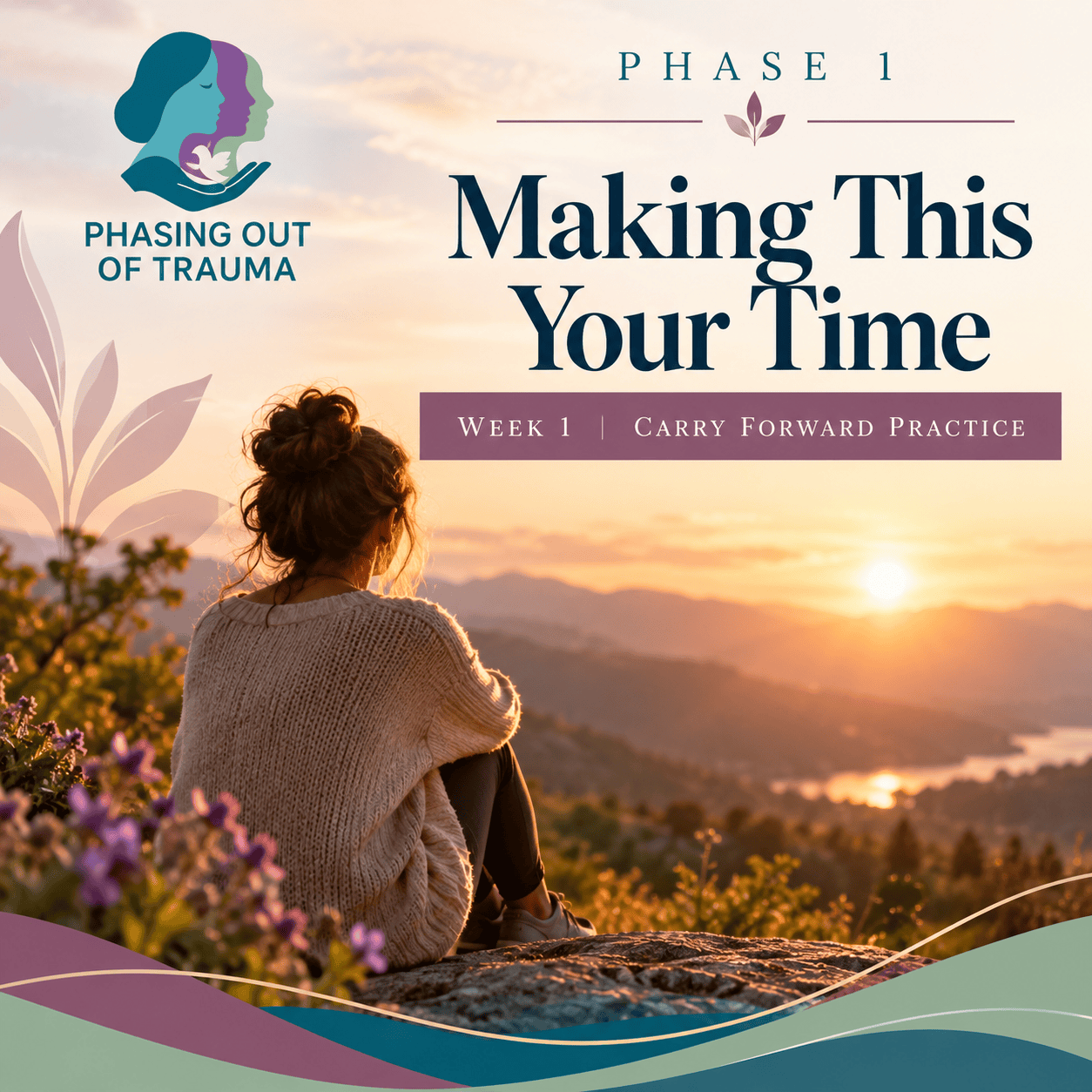
At the beginning of Phase 1 we help our members understand that they do not need to extend themselves beyond what they are capable of, and that they have permission to listen to their bodies, their thoughts, and their behaviors to know when “enough is enough” both within their healing work, and within day-to-day activities, and we give them permission to reclaim empowerment over their time.
As you continue on this journey, remember, this is your journey, and you cannot do it wrong. It is natural to want to “do it right,” especially when you have spent years watching other people’s reactions, managing expectations, or trying to stay safe. One of the first things we want you to practice is recognizing that this time belongs to you.
Trauma can pull attention away from the present and back toward what happened, what might happen, or what should have happened. It can also leave energy in the body that needs somewhere safe to go. The practices on the next pages are not meant to be performed in order or used all at once; they are options for different moments, so that you can begin learning what helps you return to yourself, to the present, and to God.
CARRY THIS FORWARD
This Is a Practice You Will Return To
Tag these pages. Making This Your Time is not only for Week 1. You will return to different parts of this practice throughout Phase 1 whenever reading, prayer, reflection, or Fellowship stirs more than you want to carry alone.
First: Take a Mental Break
Use this first whenever you notice that the material is becoming too much, too fast, or simply not right for this moment. Close the book. Put down the pen. Step into another room, get a drink of water, look around, or give yourself several minutes before deciding whether you want to return.
Pausing is not quitting. It is how you practice staying in relationship with yourself while you heal. You may say quietly: “This moment is mine. God is here with me.”
When You Feel Pulled Back Into the Past: Clap Your Hands
A sharp clap can become a present-time interruption when a memory, image, thought, or body sensation begins pulling you back into the trauma. The purpose is not to erase the memory; it is to help your body recognize that the memory is not happening right now. Clap once firmly, or several times if you need the repeated sound and movement. As you clap, orient yourself with present-time truths: “I am here.” “This is now, not then.” “I am in this room.” “That happened; it is not happening right now.” If saying “I am safe” does not feel true in the moment, do not force it. Use the truest present-tense statement available to you.
When You Feel Mad, Angry, Irritated, or Full of Energy: Stomp or Press
Anger and irritation often bring physical energy with them. When that energy needs somewhere to go, stomp your feet firmly into the floor. If stomping is not appropriate where you are, make a fist with one hand and press or pound it into the open palm of the other hand with a level of force that feels safe for your body. Let the movement carry the energy without directing it at another person or at yourself. With each movement you might say: “This is my time.” “God sees me.” “I survived.” “My anger is allowed to tell me something matters.”
When Closing the Book Is Not Enough: Take a Short Walk
Use the walk when you feel overwhelmed, hopeless, doubtful, or unable to settle simply by stepping away from the material. If possible, move somewhere you can see the sky, plants, trees, water, sunlight, clouds, or another part of creation. Let your eyes move outward instead of staying fixed on the difficult material. As you walk, notice what is still alive and being sustained around you. You are not trying to convince yourself that everything is beautiful or that what happened to you was good. You are reminding yourself that trauma is not the whole created world, and it is not the whole of your future.
Remember the Threefold God
As you walk, remember that you do not have only one distant idea of God on your side. The Father created you and continues to hold your life. Jesus knows suffering from within human life and remains with you in what hurts. The Holy Spirit is present within and around you as comforter, advocate, guide, and giver of life. Father, Son, and Holy Spirit are not working against one another; God is for your dignity, your healing, your good, and your restoration even though God did not desire the trauma you endured. You may name what you see as you walk: “I see the sky.” “I see something growing.” “I see light.” “I see movement.” Then remind yourself: “The God who made this creation has not stopped creating possibilities for my life.”
Walk the Scripture Path
These passages are arranged as a path. Read them slowly in order when hopelessness, doubt, or old spiritual messages tell you that you must climb out of your suffering alone. The movement is intentional: God lifts me. God sees me. God proclaims restoration and favor over lives that have known devastation.
Psalm 40:2
God lifts me out of the pit and establishes my footing. — KJV
He brought me up also out of an horrible pit, out of the miry clay,
and set my feet upon a rock, and established my goings.
Genesis 16:13
God sees me in the wilderness. — KJV
And she called the name of the LORD that spake unto her,
Thou God seest me: for she said, Have I also here looked after him that seeth me?
Isaiah 61:1–3
God binds what is broken, proclaims favor and liberty, and promises beauty where there have been ashes. — KJV
“The Spirit of the Lord GOD is upon me;
because the LORD hath anointed me to preach good tidings unto the meek;
he hath sent me to bind up the brokenhearted,
to proclaim liberty to the captives,
and the opening of the prison to them that are bound;
To proclaim the acceptable year of the LORD,
and the day of vengeance of our God;
to comfort all that mourn;
To appoint unto them that mourn in Zion,
to give unto them beauty for ashes,
the oil of joy for mourning,
the garment of praise for the spirit of heaviness;
that they might be called trees of righteousness,
the planting of the LORD, that he might be glorified.”
A Hymn to Hold Onto
When you need language for the unfinished place—when healing has not happened yet and you simply need God to remain—carry this first verse of the hymn Abide with Me with you. You can speak it slowly, sing it quietly, or write it on a card and keep it with your workbook.
Abide with me: fast falls the eventide;
the darkness deepens; Lord, with me abide.
When other helpers fail and comforts flee,
Help of the helpless, O abide with me.
Henry Francis Lyte, “Abide with Me”
When You Feel Like You Do Not Matter: Feel Your Heartbeat
Place your hand over your heart, or find your pulse at your wrist or neck. Stay long enough to notice that your body is carrying out thousands of coordinated tasks without your having to command each one. Your heart is beating; your lungs are exchanging air; your brain and nervous system are receiving information; your body is continually working to sustain the life God gave you. You are not a copy God accidentally repeated. God created you with intellect, emotions, spirituality, physicality, memory, personality, gifts, preferences, and a way of being that belongs specifically to you. God does not need another clone of Jesus or of someone you admire; He desired you to exist, or you would not be here as this particular person. As you feel your heartbeat, say slowly: “This heart still beats.” “God made this heart.” “God sees this heart.” “My life matters to God.” “I am allowed to take up the space of the person God created.”
When Worry, Anxiety, or Impatience Takes Over: Give Your Hands Something to Do
Use this when your mind begins racing, when worry loops keep repeating, or when you become discouraged that healing is not moving quickly enough. Giving your hands a simple, repetitive task can help communicate to the nervous system that it does not have to solve the entire problem right now. Rub your hands together slowly. Hold a smooth stone and trace its edges. Knit, crochet, fold laundry, doodle, color, knead dough, garden, work a simple puzzle, or squeeze a stress ball. Choose something that does not require you to perform well; the purpose is rhythm, contact, and enough structure to let the mind quiet. If you use a stone, you might whisper: “God is my Rock.” If you trace your hand on paper, label the fingers with words you need to remember: Loved. Seen. Safe enough for this moment. Strong. Growing. Let your hands do something small while God holds what is larger than you can solve today.
When You Need a Moment of Peace: Smell Something Soothing
Scent reaches memory and emotion quickly, which is why a familiar, gentle aroma can become a cue for rest. Use this when you are not necessarily flooded or angry, but you need a few minutes of comfort, quiet, or peace before deciding what comes next. Choose only scents that feel pleasant and safe to you; if a scent carries an unwanted memory, choose another.
Lavender: Use for calm; pair it with “He restores my soul.”
Vanilla or cinnamon: Use for warmth and comfort; recall a genuinely safe or nourishing memory if one is available.
Cedar or frankincense: Use for grounding; imagine yourself held in God’s steady presence.
Citrus or mint: Use when you want clarity or gentle awakening.
Coffee, tea, bread, or another familiar food aroma: Use when the scent evokes belonging, ordinary life, or home in a way that is comforting to you.
Afterward, notice whether anything shifted in your breathing, muscles, thoughts, or sense of time. You are not measuring whether the practice “worked.” You are learning your own nervous system and building a collection of ways to return to the present.
CARRY THIS FORWARD
Until next time...
May God give you the courage to face today,
the wisdom to recognize what you’re feeling,
the strength to take your next step,
and the grace to live each day with intention.
Because you matter.