God's Invitation to Welcome Responsibility
For many women, the word responsibility doesn’t arrive as a neutral concept. It carries memory. It can echo voices that demanded too much before safety was ever established, or moments when blame was cloaked in moral or spiritual language and handed to someone who was already overwhelmed. Responsibility can feel like pressure added to a life that has long been shaped by endurance rather than choice.
In trauma recovery, responsibility has to be reclaimed carefully—not discarded, and never weaponized. When held rightly, responsibility does not crush the wounded. It restores dignity. It returns agency to women who learned how to survive without it, and it opens the door to something many have not experienced in a long time: the ability to choose their lives with intention rather than simply endure them.
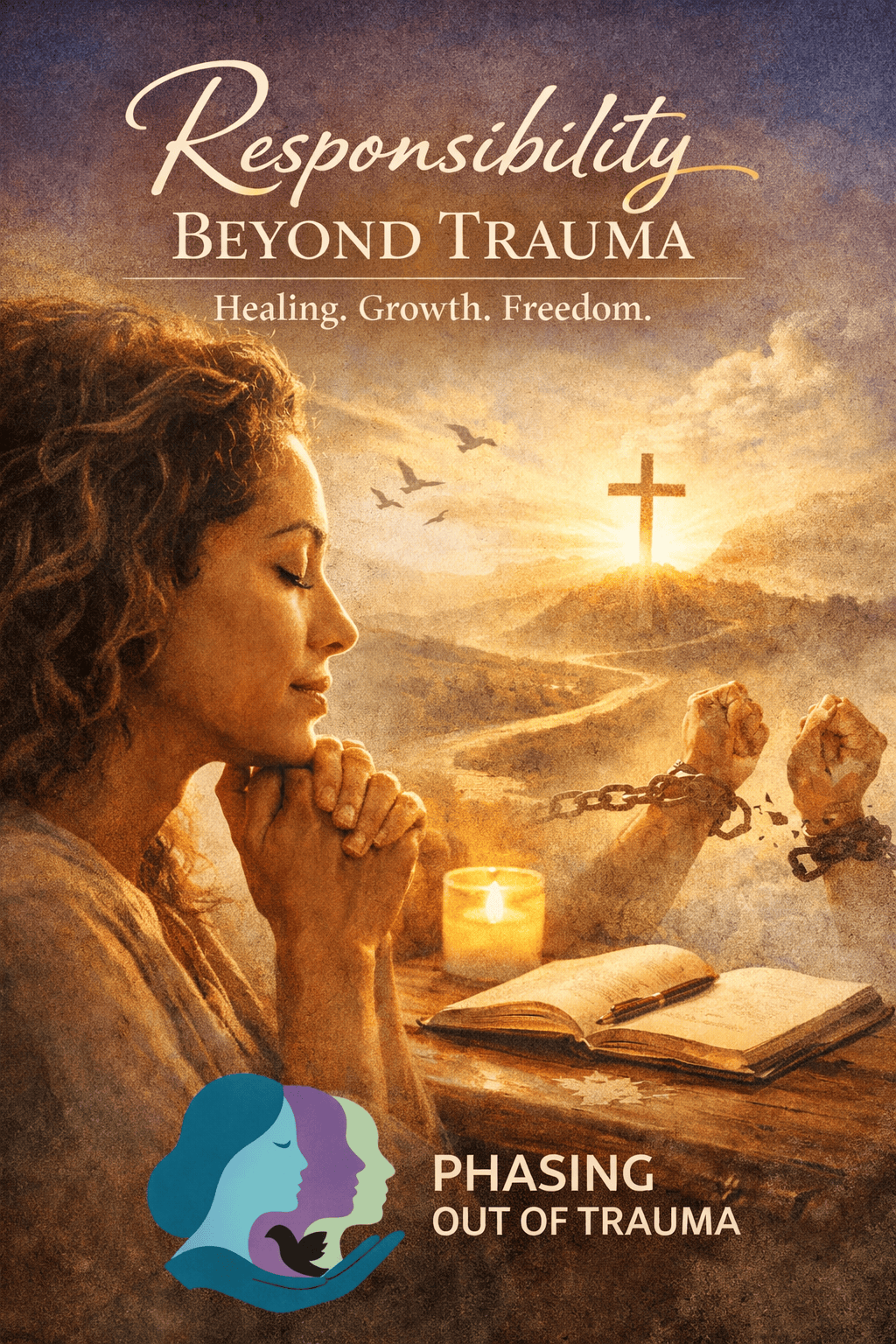
This is why the question Jesus asks—“Do you want to be made well?” (John 5:6)—is so significant. It is not an accusation or a demand. It is an invitation into partnership. It honors suffering while also awakening agency. Responsibility, in this sense, is not about blame or earning healing; it is about responding to the possibility of restoration. And when a woman begins to answer that question for herself, responsibility becomes one of the clearest signs that she is no longer living only in survival, but stepping into a life that is being consciously—and courageously—chosen.
Responsibility Begins With the Choice to Heal — The First Act of Agency
For many women who enter Phasing Out of Trauma, the first meaningful responsibility they take is not moral or relational—it is internal. It is the quiet but courageous decision to show up. To name pain rather than continue burying it. To engage a process instead of enduring in silence. To stop waiting for rescue and begin participating in their own restoration. This choice may not look dramatic from the outside, but it is profound, because trauma so often strips people of agency, teaching passivity, hyper-adaptation, or disappearance as the safest ways to survive.
Healing begins when a woman makes a different kind of decision—one that may feel small but carries enormous weight. She decides, sometimes for the first time, I will no longer abandon myself. That decision is the first true act of agency. It is not about fixing everything or knowing what comes next; it is about choosing presence over absence and honesty over numbing.
This is why that earlier question Jesus asks carries so much weight. It is not about worthiness or pressure, and it is never coercive. God does not force healing on us, nor does He rush our readiness. Instead, He continually invites us—day by day, and often moment by moment—into participation. Taking responsibility for healing means choosing, again and again, to stay engaged in the journey: to return when we feel overwhelmed, to reach for support when we want to withdraw, to practice what restores us even when it feels slow. This kind of responsibility is not about getting it right; it is about remaining present. It is the doorway through which agency keeps returning, one choice at a time, as we continue walking the path of healing with God.
The Trauma You Live With Was Not Your Fault
Before responsibility can widen or deepen, one truth must be stated clearly and without qualification: the trauma you are living with is not your fault. Trauma does not arise from personal weakness or failure. It emerges from experiences where power was misused, boundaries were violated, protection failed, or harm was allowed to continue. Abuse, neglect, betrayal, violence, and injustice do not happen in isolation, and they do not happen without responsibility belonging somewhere outside the survivor.
Trauma experts have been unequivocal on this point. Bessel van der Kolk reminds us that trauma is not defined by what is “wrong” with a person, but by what happened to them and how their body and nervous system adapted to survive. Survival responses—freezing, appeasing, dissociating, enduring—are not moral failures; they are biological and psychological strategies that kept a person alive. Naming this clearly is not avoidance of responsibility; it is the foundation of healing.
Moral clarity matters because when responsibility is misassigned, harm multiplies. Survivors end up carrying guilt that does not belong to them, while those who caused harm—or benefited from silence—remain unexamined. This distortion does not heal trauma; it compounds it. Scripture itself refuses this confusion, reminding us that God “rescues the weak and the needy” and does not confuse the victim with the offender (Psalm 82:4). Healing requires that truth be told plainly.
This pattern of misplaced responsibility is explored in Mistakes Were Made (But Not by Me), where the authors explain how human beings instinctively avoid accountability in order to protect their self-image. Denial, minimization, and rationalization allow harm to remain unaddressed and unresolved. For survivors, understanding this dynamic can be profoundly stabilizing—it clarifies that the weight they have carried was never meant to be theirs alone.
This is why learning to distinguish what is not yours to carry is as essential as learning what is. Healing requires responsibility to be accurately placed—neither inflated through false guilt nor erased through denial. When responsibility is named truthfully, survivors are freed from self-blame, and the path forward becomes clearer, steadier, and grounded in reality rather than shame.
Taking Responsibility for How We Lived While Surviving
As safety and capacity grow, many women arrive at a tender and often surprising realization: survival shaped them. Not just internally, but practically. Trauma does not only leave memories behind; it leaves patterns. It teaches the body and mind how to get through what felt impossible at the time.
For some women, that meant learning to withdraw—to stay small, quiet, or unseen because visibility once felt dangerous. For others, it meant hyper-control: managing everything and everyone because unpredictability was terrifying. Some learned to people-please to preserve connection, to numb emotions to survive overwhelm, or to stay in a constant state of alertness because danger once arrived without warning. These behaviors were not random. They were intelligent, adaptive responses to unsafe environments. They helped women endure what could not be changed.
But what once protected can later begin to constrain.
As life becomes safer, the same patterns that once kept a woman alive may start to cost her intimacy, peace, or freedom. She may notice that she avoids conflict even when her needs matter, or that she stays guarded in relationships that are no longer threatening. She may realize that anger still flares quickly, or that shutting down has become automatic even when she wants connection. Healing does not require judging these patterns—it allows them to be seen clearly and compassionately.
This is where trauma-informed accountability becomes possible. Janina Fisher reminds us that many survival behaviors are protective parts of the self—strategies that developed when there were no better options. Healing invites curiosity rather than condemnation. A woman may gently say, “This made sense then. It kept me safe. And I don’t want to keep living this way now.” That statement alone marks profound growth.
This is also where accountability becomes liberating rather than punishing. Dana Coverstone describes accountability as alignment rather than self-attack. Simple accountability does not dramatize failure or demand endless explanation. It names what is true and chooses redirection. It sounds like honesty without humiliation and responsibility without collapse.
In trauma recovery, this means understanding why a behavior emerged while also acknowledging its impact—on oneself and on others. A woman may recognize that withdrawal once protected her, but now keeps her isolated. She may see that control once created safety, but now strains relationships. Accountability allows her to hold both truths at once. It creates space for change without erasing context, and growth without self-hatred. In that space, responsibility becomes not a burden, but a pathway forward—one that honors the past while making room for a different future.
How Responsibility Brings Health and Safety Into Our Relationships
As responsibility deepens, it begins to take relational form. Healing is no longer something that happens only within us; it reshapes how we engage with others, how we repair what can be repaired, and how we protect what must be protected. This is where responsibility becomes practical, embodied, and deeply life-giving.
In this stage of healing, confession—rightly understood—becomes a tool for creating greater health, not a requirement for exposure. In The Art of Confession, Paul Wilkes reframes confession as an act of liberation rather than humiliation. Confession, he explains, is not about self-loathing or public self-disclosure; it is about truth that restores integrity and makes forward movement possible. For trauma survivors, this distinction is essential.
In supportive, safe relationships, confession can be a powerful way to own harmful actions and demonstrate change. A woman may name how survival patterns—withdrawal, control, reactivity, silence—have impacted others, not to punish herself, but to repair trust. Confession in these spaces sounds like honesty paired with responsibility: This is how I showed up. This is how it affected you. And this is how I am choosing to live differently now. When offered freely and received safely, this kind of confession strengthens connection and signals growth.
At the same time, trauma-informed responsibility recognizes that confession is not always meant for every relationship. Many women have histories of being exposed without consent, silenced when they spoke, or harmed further by sharing truth in unsafe spaces. Healing does not require continued vulnerability in relationships that remain dismissive, manipulative, or abusive. In those cases, confession may take a different and equally important form: self-confession.
Self-confession allows a woman to name, with clarity and compassion, where she has continued to tolerate harm, override her own needs, or remain in relationships that diminish her well-being. This is not self-blame—it is discernment. Naming these patterns creates the clarity needed to establish boundaries of protection. In this way, responsibility is expressed not through disclosure, but through limits. Through choosing distance instead of exposure. Through saying, I will no longer place myself in harm’s way.
Used wisely, confession becomes a marker of maturity rather than vulnerability alone. It helps repair what can be repaired and safeguards what must be protected. It reflects a new kind of responsibility—one that honors growth, values safety, and actively shapes a healthier future. In this way, responsibility does not tether a woman to her past; it equips her to move forward with strength, wisdom, and integrity.
What Trauma Experts Teach About Responsibility
Trauma research consistently confirms what survivors already know in their bodies: responsibility cannot be demanded before safety exists. Accountability that arrives too early does not empower—it overwhelms. When the nervous system is still bracing for threat, responsibility feels like danger rather than choice, and expectation feels like pressure rather than invitation. Trauma-informed healing understands that responsibility must be grown, not imposed.
Bessel van der Kolk has been clear that agency depends on regulation. A nervous system locked in survival mode cannot access meaningful choice. In states of fight, flight, freeze, or collapse, the body is focused on protection, not reflection. From this perspective, responsibility does not begin with behavior correction—it begins with restoring safety in the body. Only when the nervous system settles can a person truly choose, respond, and take ownership in ways that are life-giving rather than self-punishing.
Building on this, Janina Fisher emphasizes that healing requires learning to hold oneself accountable without internal attack. Many trauma survivors have highly developed inner critics that confuse responsibility with self-condemnation. Fisher teaches that shame shuts down learning, while curiosity keeps the nervous system open. In healthy healing, responsibility shows up first as awareness—I notice this pattern—then as compassion—I understand why it developed—and eventually as choice—I can respond differently now. Accountability, in this model, is a sign of integration rather than judgment.
Tim Fletcher adds an important relational dimension to this conversation. Fletcher often speaks about responsibility as one of the clearest indicators that a person is moving out of emotional immaturity and into wholeness. In early trauma recovery, people may externalize responsibility entirely or internalize it excessively. As healing progresses, responsibility becomes more balanced. A person begins to own their emotions, reactions, and choices without taking responsibility for others’ behavior. This shift—owning self while releasing responsibility for others—is a significant marker of emotional health.
Similarly, Gabor Maté frames responsibility as inseparable from self-awareness and compassion. Maté teaches that trauma often disconnects people from their authentic needs and boundaries, leading them to override themselves in order to maintain attachment or safety. Healing restores the capacity to take responsibility for one’s inner life—emotions, limits, values—without shame. From this perspective, responsibility expands as a person reconnects with themselves. It becomes less about control and more about alignment with truth.
Taken together, these voices offer a consistent message: responsibility is not a prerequisite for healing; it is a product of healing. It forms as safety is established, expands as awareness grows, and matures as integration takes place. Trauma-informed responsibility is relationally supported, paced with capacity, and always separated from condemnation. It does not disappear in healing—it becomes one of the clearest signs that healing is actually happening.
Responsibility in the Present: The Life Being Chosen Now
As healing stabilizes, responsibility naturally begins to shift away from the past and toward the present. Earlier in the journey, much of the work centered on understanding what happened, naming harm accurately, and restoring safety. But as capacity grows, a different question starts to rise—not only What happened to me? but How am I living now? This is not a departure from trauma work; it is evidence that healing is taking root.
Scripture speaks plainly into this stage when it invites us to “test our own actions.” This is not harsh scrutiny or self-surveillance. It is an invitation to integrity. It reflects a growing ability to look honestly at our lives without collapsing into shame or defensiveness. Responsibility here is no longer about surviving the past; it is about stewarding the present.
This is the heart of Phase 15: I can take responsibility for my maladaptive behaviors. I seek forgiveness in a way that honors me, honors God, and supports my continued healing. By this stage, women are often able to see how trauma shaped certain patterns—reactivity, avoidance, control, emotional withdrawal, or numbing—and to name them not as character flaws, but as strategies that no longer serve the life they are choosing now.
Responsibility in Phase 15 may look like recognizing that anger once protected you, but now damages connection. It may mean acknowledging that people-pleasing helped you stay safe, but now erodes your sense of self. It may involve seeing how shutting down avoided pain, but now blocks intimacy. Taking responsibility does not mean condemning these behaviors; it means owning their impact and choosing differently with the tools and support you now have.
Forgiveness at this stage is also reframed. It is not rushed, coerced, or performative. Seeking forgiveness may involve repairing a relationship where it is safe and appropriate—naming harm honestly, taking responsibility without over-explaining, and demonstrating change over time. In other cases, forgiveness may be inward and spiritual: releasing self-condemnation, grieving what those behaviors cost you, and allowing God’s grace to meet you where growth is still unfolding.
Just as importantly, Phase 15 honors that forgiveness does not require reconciliation with unsafe people. Responsibility may instead look like setting firmer boundaries, reducing contact, or choosing distance where continued engagement would cause harm. In this way, responsibility honors not only others, but the woman herself—and the healing God is actively cultivating in her.
This stage of responsibility is formation, not punishment. Trauma recovery does not remove moral agency; it restores it. Responsibility becomes a sign of freedom—the growing ability to pause instead of react, to choose instead of repeat, and to live in alignment with values rather than survival instincts. As women move through Phase 15, responsibility becomes less about what trauma shaped, and more about who they are becoming as they move beyond it—grounded, discerning, and increasingly free.
Responsibility as the Path Into Fullness
Trauma teaches survival.
Healing teaches choice.
And responsibility, rightly held, allows a woman to step into the fullness of who God is restoring her to be.
Jesus did not promise mere survival. He promised abundant life. Responsibility is not what chains us to the past — it is what anchors us in the present and opens the future.
Closing Reflection
I am not responsible for what was done to me.
I am responsible for how I live now.
With God’s help, I choose healing.
I choose integrity.
I choose life.