Phase 16: Relationships After Trauma
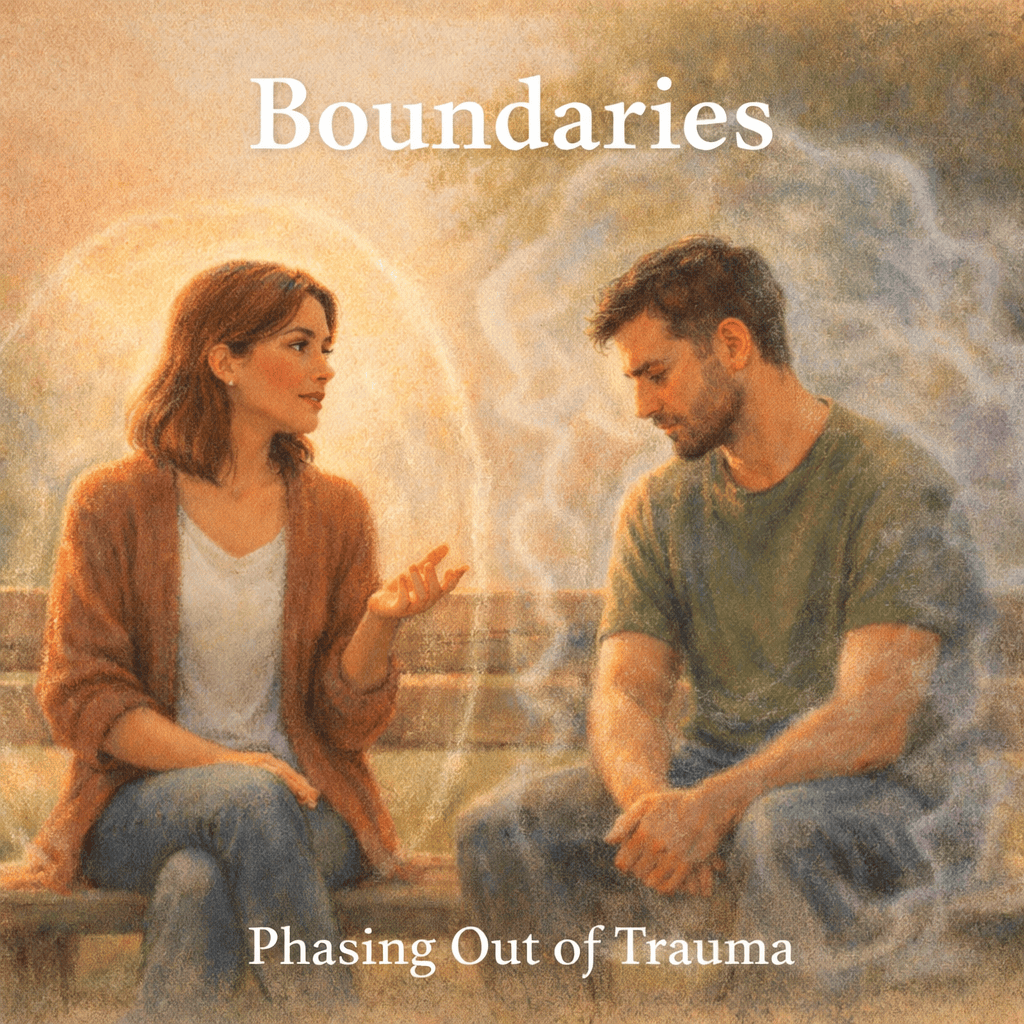
When we begin talking about boundaries, most people do not feel empowered — they feel uneasy. For some, the word carries the weight of conflict. For others, it feels selfish, unkind, or even unspiritual. Many trauma survivors were never taught healthy limits; instead, they experienced either rigid control or total emotional chaos. So when we arrive at Phase 16 and begin exploring relationships after trauma, boundaries can feel foreign — or frightening.
And yet, boundaries are not walls.
They are doorways with hinges.
Trauma psychiatrist Bessel van der Kolk teaches that trauma reshapes the nervous system. It changes how we experience safety, connection, and agency. Trauma is not simply an event that happened; it is an imprint on the body. When safety was repeatedly violated — emotionally, physically, or relationally — the body learned to adapt in order to survive. Some adapted by becoming hyper-attuned to others’ needs, scanning constantly for approval. Others adapted by disconnecting from their own emotions altogether. Some learned that “no” led to punishment. Others learned that having needs meant being too much.
Over time, survival patterns that once served to keep us safe with an individual, or in certain situations become hard wired into universal relational styles we use with everyone in every situation, and we rationalize it rather than pathologize it - because it's all we've known. People-pleasing begins to look like kindness. Over-giving masquerades as love. Silence becomes self-control. Avoidance becomes independence. But beneath these patterns is often a nervous system that never felt safe enough to differentiate where one person ends and another begins.
Boundaries restore that differentiation where we're able to recognize that we're not being kind to ourselves when we're going out of our way to make our boss's life easier at the detriment to our family. Where we can see that constantly buying our kids the newest toys, games, electronic does not fill their love tank and make up for our inability to spend time with them. We can recognize that stonewalling our beloveds isn't about giving us time to make up our minds, it's about controlling our calendar. They help us recognize that we are not called to be independent - we are called to agency and empowerment within interdependence on supportive people.
Boundaries help us answer a fundamental question trauma disrupts: What belongs to me, and what does not?
When we've grown up with Adverse Childhood Experiences, and when we've experienced trauma in pivotal years or our adulthood, and when we've had dysfunction in our families, it's easy to understand. Most of us can relate to someone in our families or at school or at work that doesn't seem to "pull their weight" and most of us can recognize the person who always "bails them out". We can also recognize the people in our lives who are "loners" and who don't work well in groups because they don't know how to ask for help, and those who just ride their coat tails and take credit they don't deserve. Why are these things so common in our experiences?
Attachment theory deepens this understanding. Clinical psychologist Sue Johnson reminds us that human beings are wired for connection. We are not meant to be emotionally self-contained. We long for closeness, responsiveness, and reassurance, and as babies we do our best to achieve healthy attachment with the caregivers we have. But when attachment has been insecure or chaotic, boundaries feel risky, this could be something we experience very early in life, or it could be something that develops later in fundamental years as dysfunction grows or develops in our lives.
This means, if someone grew up anxiously attached where they never knew if their needs would be met, and they had to perform to be affirmed and accepted, setting a boundary may feel like threatening the relationship itself. The internal message might sound like: If I say no, they will leave. If I disappoint them, I will lose them. If I create distance, I will be abandoned. This is not irrational thought - this thought comes from deeply stored, powerful memories of how people left, carried disappointment, and abandonment because they didn't live up to impossible or constantly changing standards of their caregivers or within their primary relationships.
Conversely, someone with avoidant attachment, who rather than getting needs met by caregivers was abused, or suffered further harm when they were near, may feel engulfed by closeness. For them, boundaries may not be missing — they may be rigid and defensive. The internal narrative becomes: If I let you in, I will lose myself. If I depend on you, I will be hurt. Again, this makes sense, as their definition of "love" is distorted by the unhealthy behaviors of caregivers and primary relationships from their past.
Healthy boundaries actually helps us heal our attachment styles, because they do not sever attachment. They make secure attachment possible.
When expectations are clear - meaning I know what you want from me, and I can clearly let you know what I need from you, when emotional responsibility is not blurred - meaning I am not condemned for how I feel, and I am free to feel it full, and when each person is accountable for their own behavior - meaning you're not "making me do anything" I'm choosing to do this because I respect my dignity or because I'm taking my mental and spiritual health serious, relationships become more stable.
Clarity reduces anxiety, we don't need to wonder and stay in panic, because of misunderstandings. Predictability reduces threat, we don't need to say "If you do this again...." and then be love bombed into taking it back. Mutuality increases trust, both parties agree to the boundary, and as the boundary is upheld, true trust forms.
Boundaries are not anti-connection; they are the conditions under which connection becomes safe. We set boundaries in order to open the door to vulnerability - boundaries tell the other person about our needs, and ask them to respect them, when we see people respect our needs, we're more likely to ask them to help meet them, and to support us in getting additional needs met down the line.
Boundaries and the Body
Attachment styles are a neurological process, and we can see how insecure attachment styles can lead to poor boundaries based on emotional and cognitive feedback. It's fairly easy to see that poor boundaries negatively affect our mental and emotional states, but it goes beyond that. Neuroscientist Stephen Porges, through his work on Polyvagal Theory, explains that safety is not primarily cognitive — it is physiological. The nervous system is constantly scanning for cues of danger or safety. When boundaries are unclear, the body often remains in a low-grade state of alert. We brace for intrusion - yes, our bodies literally harden. We anticipate conflict - yes, we activate stress responses before the conflict ever occurs. We over-explain and apologize for existing - yes we physically diminish ourselves . Or we shut down to avoid overwhelm - yes we turn off biological systems, and stop healthy physical functioning.
A boundary sends a signal to the nervous system: There is structure here. There is clarity. There is agency.
And agency calms the body, allows it to soften and release, allows it to rest an digest, allows it to return to proper hormonal function, metabolic function, and immune-function.
Without boundaries, relationships tend to swing between enmeshment - where we take on the emotional, phsyical and mental responsibilities of the other person, and we let them take on ours, and isolation where we refuse to let someone in because we've already decided they're not trust worthy, and we're just using them for personal gain, as a means to an end. With boundaries, relationships develop rhythm. There is room for closeness when desired and needed and space when warranted and agreed upon. There is room for honesty, vulnerability and discovery and respect for differences without condemnation. There is room for repair when rupture occurs, and recognition that ruptures are healthy as disagreements should happen in a natural flow of every relationship. This rhythm is what allows intimacy to deepen rather than collapse.
Are Boundaries Spiritually Pleasing to God?
Many fundamentalist Christian churches will tell you that to set a boundary is non-Christian. That we are called to die to self, and to take up the crosses the world gives us. However, we are told to love others as we love ourselves, and that God calls us to live a life of abundance, while we carry our own loads and bear the burdens of those around us. Let's look at how boundaries truly coincide with our Christian faith.
From a spiritual perspective, boundaries are not a modern therapeutic invention. They are embedded in creation. In Genesis, God separates light from darkness, land from sea, day from night. Separation is not rejection; it is order. It is differentiation that allows life to flourish. Even Christ modeled relational boundaries. He withdrew to pray. He did not heal every person in every town. He allowed others to misunderstand Him. He did not abandon His calling to satisfy every demand placed upon Him.
Spiritual maturity is not self-erasure.
It is stewardship.
We are invited to become more Christ-like, but we are not called to become Christ Himself.
Part of spiritual growth is relinquishing the subtle temptation to become the redeemer, savior, or lord of the people around us. When we over-function, over-commit, and overextend in the name of service, we can unintentionally step into roles that were never ours to carry. We begin to believe that everything depends on us — that if we do not hold it together, no one will. That posture may look sacrificial, but it is often rooted in anxiety rather than trust.
Our lives are meant to point to Christ — not because we are striving to mimic Him perfectly, but because His work in us becomes visible. When people see transformation, peace, humility, and regulated strength in our lives, they grow curious about the source. But if what they see instead is exhaustion, irritability, martyrdom, and chronic over extension, the life we model does not look like good news.
Boundaries free us from playing God.
They allow us to say yes when we have capacity and no when we do not. They invite us to ask for help. They permit us to rest. They protect our nervous systems so that our love does not turn sharp and brittle. They keep our service aligned with calling rather than compulsion.
Perhaps the most Christ-like thing we can do is trust that we are not Christ. When we live honestly — acknowledging our limits, honoring our bodies, refusing to over commit — our lives begin to look sustainable. They look peaceful. They look real. And that kind of life, grounded and wholehearted, becomes deeply compelling.
Not because we disappeared. But because we finally showed up as who God actually created us to be.
What Exactly are Boundaries?
It is important to clarify what boundaries are — and what they are not. A boundary is not an attempt to control someone else’s behavior. It is not a silent punishment or a withdrawal meant to induce guilt. A boundary does not say, “You must change.” It says, “This is what I will do if this continues.” It centers responsibility where it belongs — with the self.
For example, instead of saying, “You need to stop yelling,” a boundary might sound like, “If the yelling continues, I will leave the room.” Instead of demanding emotional availability, it may sound like, “I need time to think before responding.” Boundaries focus on one’s own participation.
For trauma survivors, this shift can feel destabilizing. Setting a boundary may activate guilt, shame, or fear of abandonment. The body may react as though danger is imminent. This does not mean the boundary is wrong. It means the nervous system is recalibrating. It is learning that disagreement does not equal catastrophe. It is learning that love can survive clarity.
This recalibration takes practice. In Phase 16, we encourage starting small. Notice where resentment is building — resentment is often a signal that a boundary is needed. Notice where your body tightens before saying yes. Notice where you feel obligated rather than willing. Practice low-risk acts of honesty. Build tolerance for the discomfort that comes with change.
Healing is not becoming harder.
It is becoming clearer.
There is a paradox at the heart of boundary work: healthy limits increase intimacy. When boundaries are absent, hidden anger accumulates. Unspoken expectations fester. People begin keeping score. Over time, connection erodes under the weight of confusion and resentment. But when boundaries are present, relationships gain durability. There is room for difference. There is room for negotiation. There is room for repair.
Boundaries create the architecture within which love can rest.
Phase 16 invites us to examine our relationships not through the lens of obligation, but through the lens of safety and mutuality. It asks us to consider whether we are participating from fear or from freedom. It challenges us to recognize that saying no does not diminish our worth — it affirms it.
You are allowed to take up space.
You are allowed to protect your nervous system.
You are allowed to steward your life.
Healing does not mean becoming infinitely accommodating. It means becoming rooted enough to stand without collapsing and open enough to love without disappearing.
And rooted people love well.