Can the Bible Really Speak to You?
Lectio Divina is an ancient Christian prayer practice rooted in the belief that God is still speaking through Scripture — personally, presently, and relationally. Rather than approaching the Bible for information or instruction, Lectio Divina invites us to listen. We read slowly. We notice what stirs. We allow a word or phrase to meet us where we are, trusting that God knows what we need to hear today. At Phasing Out of Trauma, we are incorporating Lectio Divina as a gentle, trauma-informed way of praying with Scripture — especially for women who may feel overwhelmed, disconnected, or unsure how to approach prayer in the midst of real life.
Scripture is rich, layered, and alive. As we start this journey of healing, it can be overwhelming to look at chunks of Biblical text, so in Phase 1 we introduce Lectio Divina using single scripture verses, and encourage women to read it as it's translated across multiple translations. we understand that no single translation can hold the full range of meaning, tone, and invitation contained within a verse if it could we wouldn't have the need to have so many different versions of the Bible.
When women are navigating trauma recovery, grief, uncertainty, or difficult news, they are often living in very specific emotional and spiritual moments. One translation may resonate deeply, while another may feel distant or inaccessible. By praying with multiple translations, we allow Scripture to:
speak in different emotional registers
emphasize different aspects of the same truth
meet each woman in the here and now of her lived experience
This practice does not dilute Scripture — it reveals its fullness. It honors the reality that God’s Word can speak comfort, courage, steadiness, hope, or care depending on what is needed in the moment.
Psalm 112:7 as a Living Example
As we walk through Phase 1, we are given multiple verses to contemplate using Lectio Divina, after accepting God's willingness to pull us out of the mire and slim and mud of the pits our trauma has cast us into, we next encounter Psalm 112:7, a verse that speaks honestly about life as it is — not as we wish it were.
Across translations, Psalm 112:7 acknowledges that bad news comes. It does not deny fear or difficulty. Instead, it turns our attention to the posture of the heart in the midst of it.

Here’s what emerges when we listen closely to Psalm 112:7 (NABRE):
“They do not fear bad news; their hearts are firm, secure in the LORD.”
The NABRE uses the words “firm” and “secure”, which point less to emotion and more to structure.
This is not about feeling unafraid. It’s about having something inside that does not collapse when bad news arrives. In trauma-informed language, this reads as: internal steadiness; groundedness; the presence of an inner anchor. The NABRE suggests that fear may still exist — but it does not dismantle the heart.
The phrase “secure in the LORD” is key. Security here is not tied to outcomes, explanations, or relief from suffering. It is relational. The heart is secure because of where it is held, not because the situation has changed. This matters deeply for women in recovery, because: circumstances may still be unstable; answers may still be absent; healing may still be unfolding. Yet security is possible now.
The NABRE’s tone is calm, almost understated. It does not use emotionally charged language. It doesn’t rush toward hope or confidence.
Instead, it names a quiet, settled orientation: the heart is firm; the heart is secure; the anchor is the Lord. This makes the NABRE especially resonant for: women further along in recovery; moments when calm has been earned slowly; seasons where faith is less expressive and more embodied.
More than any other translation, the NABRE presents trust as a place rather than a feeling.
The heart is not bracing itself.
It is not striving.
It is standing.
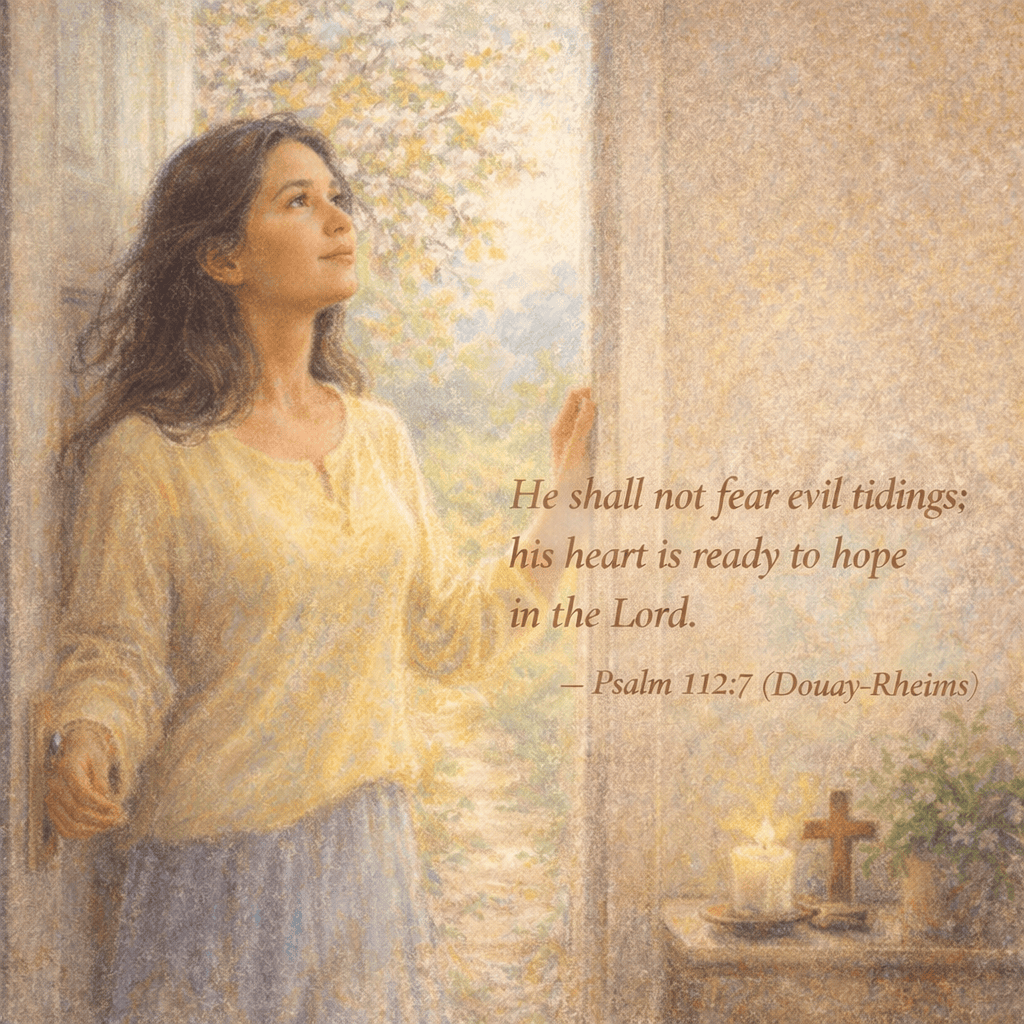
The Douay-Rheims translation carries a distinctly different spiritual tone than the others, and it’s especially tender for women in early or fragile stages of healing.
“He shall not fear evil tidings: his heart is ready to hope in the Lord.”
(Psalm 112:7, Douay-Rheims)
The phrase “ready to hope” is the heart of this translation. This does not say: that hope is already present; that fear is gone; that confidence has been achieved. Instead, it names capacity forming. The Douay-Rheims honors the moment when a person cannot yet say “I hope”, but can say:
“I am becoming able to hope.” For trauma recovery, this is profoundly merciful.
“Ready” implies preparation, gentleness, and timing. This translation recognizes that hope: is not forced; cannot be commanded; often comes after a long season of endurance. The heart is being made ready — not rushed. This is why this translation speaks so clearly to women early in healing, moments just after bad news, and seasons where faith feels thin but not absent.
The Douay-Rheims still names “evil tidings.” Bad news is real. The threat is real. But the emphasis is not on eliminating fear — it is on what is quietly growing underneath it. Hope is emerging in the presence of fear, not instead of it.
The phrase “in the Lord” anchors this hope. This is not optimism. It is not wishful thinking. It is not positive reframing. The Douay-Rheims frames hope as relational — something that rises because the heart is turning toward God, even before it knows what will happen next.
More than any other translation, the Douay-Rheims captures a threshold moment in the spiritual life.
Not despair.
Not peace.
But the sacred in-between.
It is the moment when the heart says:
“I am not there yet — but I am turning toward life.”
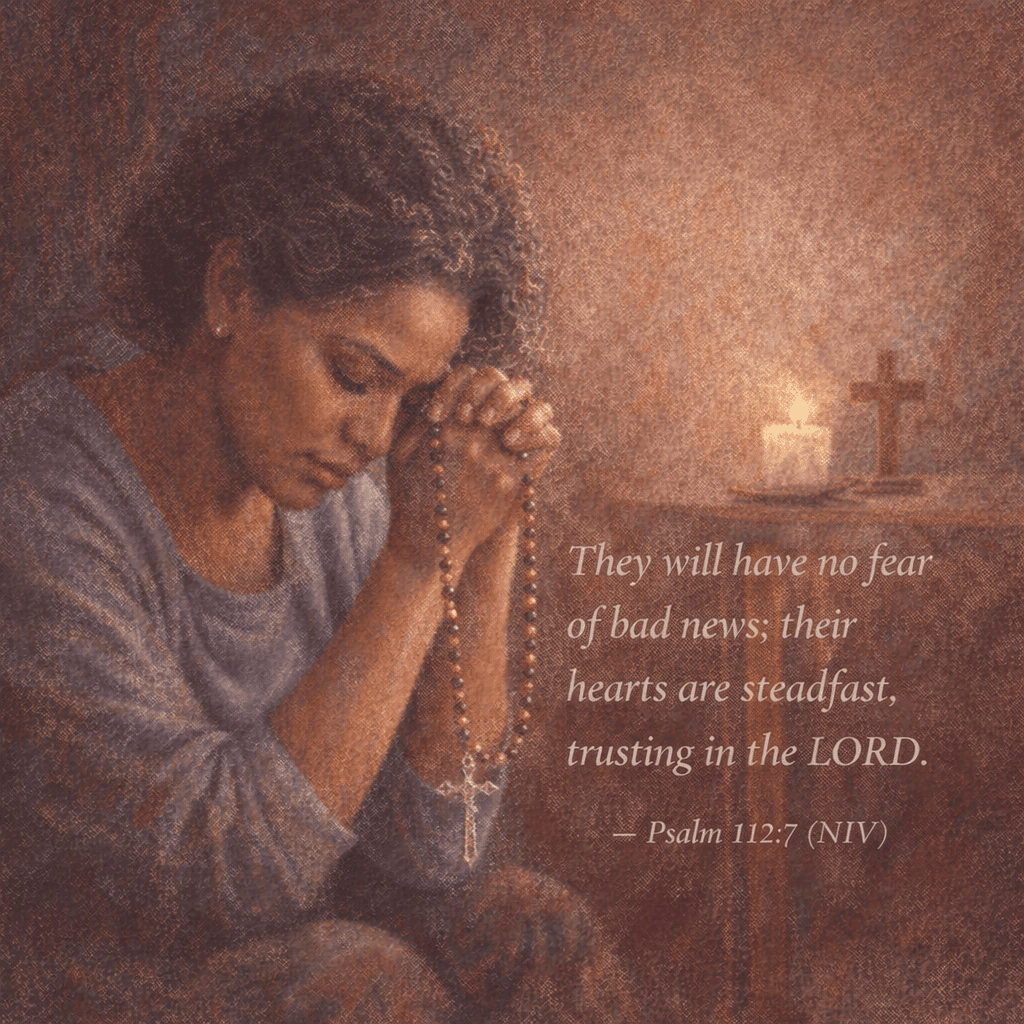
The NIV sits right in the middle of this verse’s emotional spectrum — and that’s actually its gift. It holds endurance and trust together without drifting too far toward either calm resolution or fragile emergence.
“They will have no fear of bad news; their hearts are steadfast, trusting in the LORD.”
(Psalm 112:7, NIV)
The word “steadfast” is doing the heavy lifting here. This is not a momentary state. It implies something maintained over time. In contrast to: NABRE’s settled security and Douay-Rheims’ hope beginning to form the NIV speaks to staying power. It names the kind of faith that: shows up again tomorrow; keeps choosing God; holds steady even when the situation hasn’t changed. For trauma recovery, this resonates deeply with midlife perseverance.
The NIV doesn’t say the heart is secure. It says the heart is trusting. That verb matters. Trust here is: active chosen and practiced. This translation acknowledges that trust is something we do, often repeatedly, especially when fear tries to reassert itself. This makes the NIV especially fitting for women who are carrying responsibility; supporting others while healing themselves; and continuing to function in the middle of unresolved pain
“They will have no fear of bad news” in the NIV does not read as denial — it reads as refusal to be governed by fear. This isn’t: “Fear never arises.”
It’s: “Fear does not take the lead.” The NIV allows fear to knock — but not to move in.
Stylistically, the NIV is plainspoken and grounded. It avoids elevated or poetic language. That makes it particularly accessible for everyday prayer, group settings and women who feel distanced from “religious” language. Spiritually, it communicates: “This kind of trust can live inside ordinary life.”
The NIV acts as a bridge between the other translations. It’s more active than NABRE. It is more established than Douay-Rheims. It is less interior than NRSV. It is less relationally explicit than NLT.
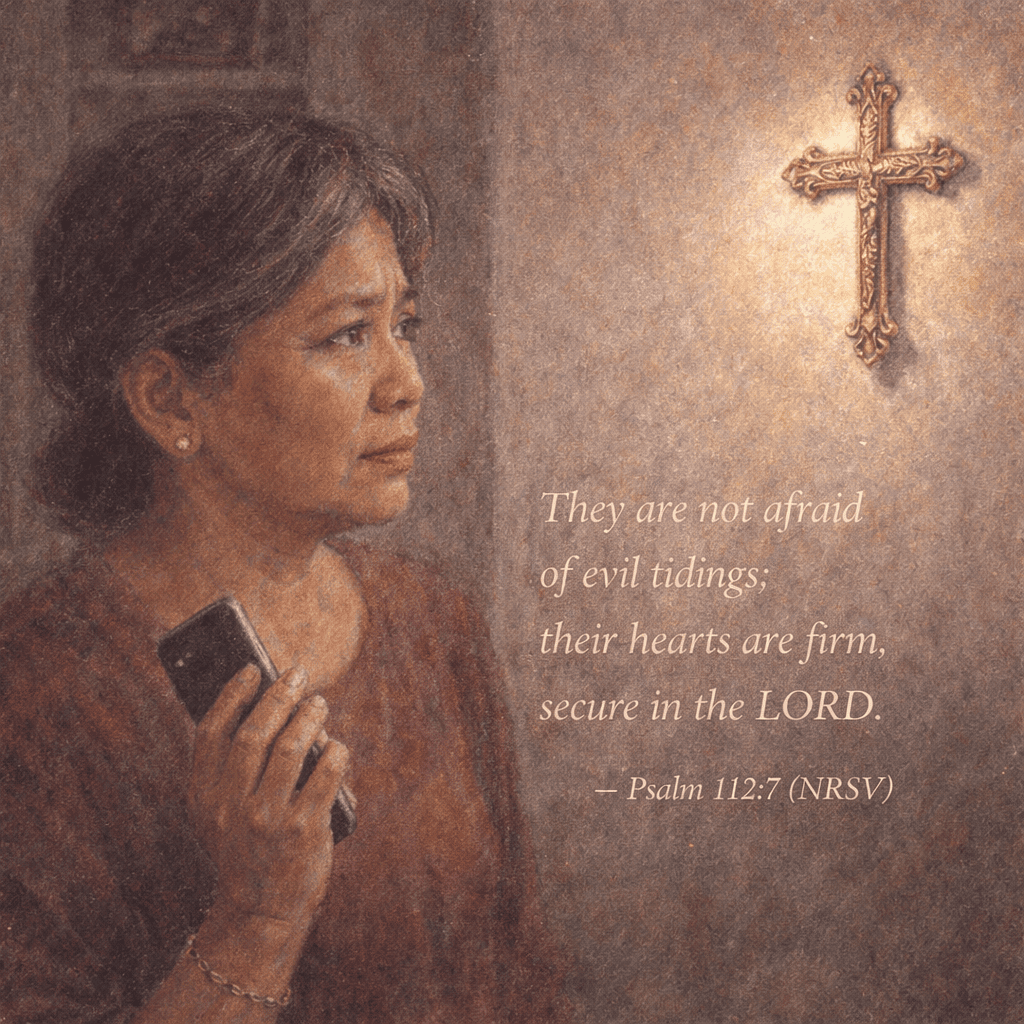
The NRSV is the most spare and unembellished of the translations we are using, and that restraint is exactly where its strength lies—especially for moments of shock or impact.
“They are not afraid of evil tidings; their hearts are firm, secure in the LORD.”
(Psalm 112:7, NRSV)
Like the NABRE, the NRSV uses “firm” and “secure”, but the tone is different. Where the NABRE feels settled, the NRSV feels resolved. There is no emotional padding here. It offers no softening language. No explanation. This is faith that stands without commentary. For trauma recovery, this matters in moments when words feel inadequate, emotion is frozen or explanation would feel intrusive.
The NRSV gives permission to simply stand.
The phrase “evil tidings” is stark. It does not minimize the seriousness of the news. The NRSV acknowledges what just happened is not just inconvenience or a mild disruption, rather this is news that changes things. And yet, it immediately shifts to the heart’s condition. This translation is uniquely suited for the first moment after hearing bad news, when the body is still, the mind is catching up and the heart needs something solid to orient toward.
The NRSV does not describe how the person feels. It describes where the heart is positioned. “Secure in the LORD” here speaks of alignment, anchoring, and orientation. This is not reassurance. It is placement. Even if fear is present, the heart is not drifting.
The NRSV leaves space. It does not try to comfort. It does not promise ease. It does not tell us what to do next.This makes it especially appropriate for grief that is still wordless. shock that has not yet turned into emotion and prayer that is mostly silence. In trauma-informed spirituality, this is deeply respectful.
If the Douay-Rheims is movement toward hope and the NIV is endurance through practice
the NRSV is: holding steady when nothing else can move yet.
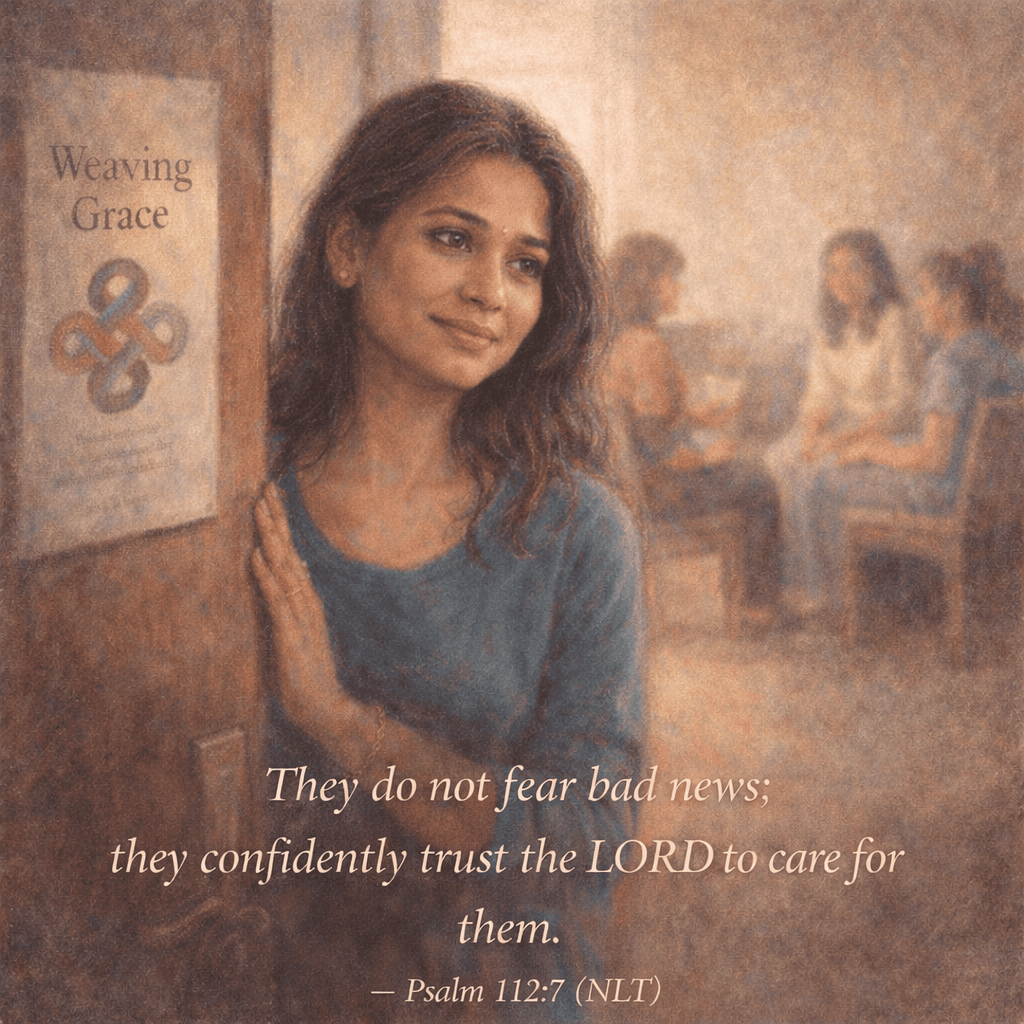
The NLT completes the arc in a really important way. Where the other translations focus on the posture of the heart, the NLT shifts the weight of the verse toward God’s action.
“They do not fear bad news; they confidently trust the LORD to care for them.”
(Psalm 112:7, NLT)
The NLT is the only translation that explicitly names care. This changes everything. The emphasis is no longer on our firmness of the heart or our steadiness of faith or even our endurance or resolve. It is on who is responsible. The NLT says: Trust looks like letting yourself be cared for. For women in trauma recovery, this is often the hardest step—and the most healing one.
Unlike the other translations, the NLT makes God the primary actor. The heart is not just firm. Hope is not just forming. Trust is not just practiced.
Instead, God is actively caring, He is presently attending, and currently holding what the we no longer have to carry alone. This speaks directly to exhaustion, burnout, and the limits of self-reliance.
“Confidently trust” in the NLT does not read as bravado or certainty. It reads as permission. This is not having to say, “I’ve got this.” It's being able to say “I don’t have to have this, because God has me.” The confidence comes from who is caring, not from the strength of the one trusting.
More than any other translation, the NLT frames trust as relational rather than internal. Faith here is not a private achievement inside the heart. It is a lived relationship where care flows toward the person. This is why the NLT naturally aligns with healing in and feeling supported by community, arrival at a place of safety, being received and accepted as you are, not as your expected to be. Trust is embodied as allowing oneself to be met.
If we look at the translations together:
NABRE — the heart is stable
Douay-Rheims — hope is becoming possible
NIV — trust is practiced over time
NRSV — the heart stands firm in impact
NLT — care is received
The NLT does not replace the others.
It fulfills them.
It answers the unspoken question underneath all the previous translations:
What makes this steadiness possible?
The answer:
The Lord cares for us.
Listening Rather Than Striving
We've just unpacked 5 translations for you, but you don't need all of that information to allow God to speak to you in the moment, there is a recgonition when the Good Shepherd speaks, we know His voice, and we hear it in our souls. When you practice Lectio Divina, you'll automatically gravitate towards the message He intends for you. And as you enter into this practice, we invite you to come back and re-read the translation(s) that have the words, phrases, or invitations He spoke over you today, and see if our interpretation of them resonates with where you are in your healing journey.
Pray Psalm 112:7 With Us
We invite you to pray Psalm 112:7 through our guided Lectio Divina video, which includes multiple translations and spacious silence for reflection.
Watch the Lectio Divina prayer on YouTube
https://youtu.be/9n0JTa4LFNs
You are welcome to pause, return, or revisit this prayer as often as needed. Lectio Divina is not about moving forward quickly — it is about allowing God’s Word to meet you gently, in real time.
Lectio Divina reminds us that Scripture is not static.
It is living — and it speaks differently in different seasons.
Through this practice, we make space to hear God’s care unfolding here and now, one word at a time.