Letting God Transform the Lie
There are moments in life when a thought settles into the mind and refuses to leave. It may begin quietly, perhaps after a painful conversation, a betrayal, a loss, or a memory that surfaces when you least expect it. A woman may find herself lying awake at night replaying something someone once said to her—You’re not enough. You should have known better. You ruined everything. Over time those thoughts can begin to feel like truth, even when they are not. They begin to shape how she sees herself, how she walks into a room, how she receives love, and even how she approaches God. What began as a moment of pain can slowly become a script that repeats in the background of everyday life.
Many women encounter these toxic thoughts in very ordinary moments. A mother may hear them when she feels she has failed her children. A woman rebuilding after divorce may hear them when she wonders whether she will ever be loved again. A survivor of abuse may hear them when shame tries to rewrite her story and convince her that what happened to her defines who she is. Even in workplaces or churches, women can carry the quiet weight of thoughts that whisper that they are invisible, unworthy, or somehow less than others around them. These thoughts can become exhausting companions, showing up in moments of vulnerability and feeding on fear, regret, and shame.
One of the most healing practices we have discovered is not trying to fight these thoughts alone, but learning to invite God into them. Instead of pushing the thought away or pretending it is not there, a woman can bring it into prayer and simply say, “Lord, this thought is here again. Will you sit with me in it?” There is something deeply disarming about allowing God to hold the thought with you. When the lie is no longer hidden or carried alone, it begins to lose some of its power. The presence of God changes the space around the thought. What once felt overwhelming begins to soften when it is held in His light.
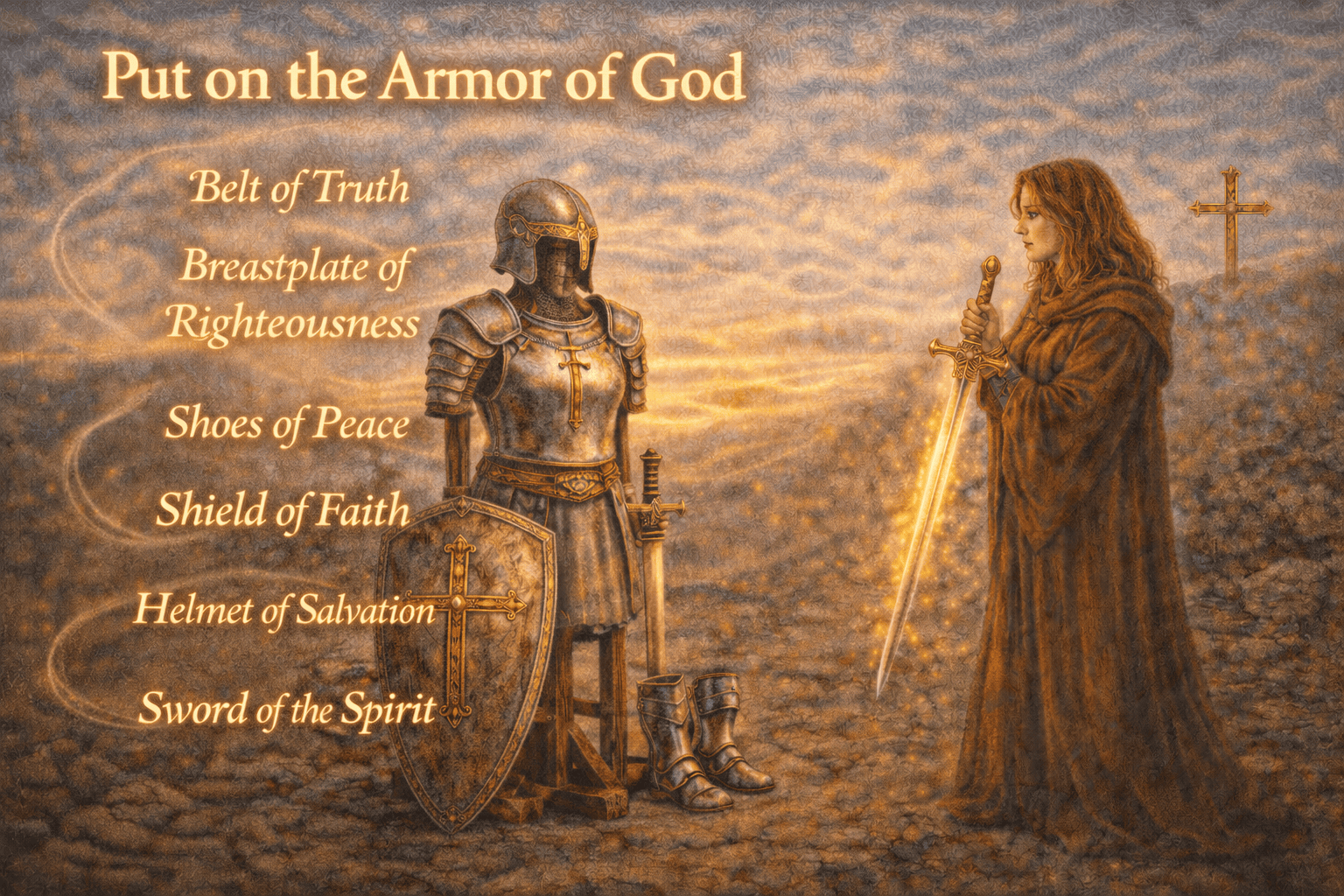
This is where the meditation on the Armor of God becomes meaningful. The armor described in Ephesians is not simply a symbolic list of spiritual tools; it is a way of remembering truths that steady us when our minds are under siege. As a woman slowly reflects on each piece—the belt of truth, the breastplate of righteousness, the shoes of peace, the shield of faith, the helmet of salvation, and the sword of the Spirit—she is gently replacing the lie with something stronger. Each piece represents a truth about who God is and who she is in Him. When those truths are embraced, the toxic thought begins to lose its authority. It no longer stands alone in her mind; it is now surrounded by truth.
Imagine a woman who carries the lingering belief that she is somehow broken beyond repair because of what she has endured. When she sits with God in that thought, she may begin to remember that righteousness was never something she had to earn—it was given to her. The breastplate of righteousness reminds her that her worth does not depend on perfection. Another woman may carry the belief that she will never find peace again after trauma or betrayal. The shoes of peace remind her that God does not ask her to stand in chaos forever; He prepares a path where peace becomes possible again, step by step. The shield of faith reminds her that even when she cannot yet see the outcome of her healing, God has already been faithful in ways she can remember.
Over time, something beautiful begins to happen. The lie that once felt immovable starts to loosen its grip. What once echoed loudly in the mind begins to fade as the truths of God become more familiar and steady. The sword of the Spirit—the Word of God—becomes the moment when a woman is able to gently speak truth back to the lie. Not with anger or force, but with quiet confidence. She begins to recognize that the thought that once controlled her does not belong to her story anymore.
Perhaps the most surprising part of this journey is what God does with the thought once it has been surrendered. God does not simply remove the pain and discard it. Instead, He transforms it. What once felt heavy and shameful can become a place of wisdom, compassion, and strength. A thought that once said you are unworthy may return as a new understanding that you are deeply loved despite everything you have carried. A memory that once felt like proof of failure may become a testimony of resilience and grace.
In the language of faith, this transformed understanding can become a rhema—a personal word from God that speaks directly to the heart. It is not just a general truth anymore; it is something that has been lived through, wrestled with, and redeemed. It becomes a message that a woman can hold onto the next time a toxic thought tries to return. Instead of being caught off guard, she can remember what God has already revealed to her.
In the meditation we practice, we imagine that this rhema—this personal truth—is placed on the belt of truth like a small reminder carried into the future. The belt of truth becomes a place where the lessons of healing are held close. Each time a lie returns, she can reach for what God has already spoken and remember that the lie has already been answered.
Healing from toxic thoughts rarely happens in a single moment. It is often a slow and patient process of allowing truth to take root where lies once lived. But when God is invited into the process, the battlefield of the mind begins to change. The thoughts that once controlled a woman’s story no longer get the final word. Instead, they become the very places where God reveals something precious—something good and pure that was hidden beneath the pain all along.
And the next time a toxic thought comes crashing into her life, she will not face it empty-handed. She will stand in truth, surrounded by grace, holding the quiet assurance that the same God who transformed that thought once before is still walking with her now.
Transforming toxic thoughts is something we help women learn to do during every phase of their healing journey with us.
We begin confronting these thoughts in Phase 1, where women are introduced to the truth that they are not defined by their trauma and that healing is possible. In Phase 2, we challenge the belief that God caused their suffering, helping women recognize that trauma is the result of human brokenness—not the will of a loving God. In Phase 3, women are invited to reconnect with emotions they may have been taught were too much, too inconvenient, or unacceptable. Instead of suppressing those feelings, we learn to acknowledge them honestly and bring them into safe spaces where they can be processed.
This work continues as we Sit With Our Trauma, the first stage of healing. During this time, women begin learning to name what happened and recognize how trauma has shaped their thoughts and beliefs. We then move into the second stage of healing, Processing Our Trauma, where deeper transformation begins to take place. Here we confront the shame that has shackled many of us for years and prevented us from recognizing our belovedness in Christ. We learn that anger is not a forbidden emotion meant to be suppressed, but an important signal that something unjust has occurred. When guided by wisdom and grounded in truth, anger can help us pursue justice, establish boundaries, and restore what has been wrongfully taken from us.
During this phase of healing we also learn to challenge the false beliefs trauma has planted in our minds—beliefs about our worth, our safety, and even about God Himself. We begin to grieve the full weight of what we have lost: not the minimized version of our story that others may have expected us to accept, but the honest and complete reality of our experience.
Finally, as we move into the last stage of healing, Moving Beyond Our Trauma, our relationship with these thoughts begins to change. By this point, many of the deeply ingrained beliefs have already been confronted and replaced with truth. What remain are the sudden, sharp thoughts that try to stop us in our tracks—the intrusive reminders that attempt to derail our pursuit of health, joy, and the life God intends us to live.
By Phase 17, women are learning to recognize these thoughts as they arise and take them captive in the moment. Rather than allowing them to dominate our minds or dictate our choices, we are able to pause, identify the lie, and respond with truth.
This meditation is one way to begin practicing that process.
As you put on the Armor of God, consider how each piece of the armor speaks directly to the lies and toxic thoughts you have battled throughout your healing journey. The Belt of Truth confronts deception. The Breastplate of Righteousness protects your identity and worth. The Shoes of Peace ground you in stability rather than fear. The Shield of Faith deflects accusations and doubts. The Helmet of Salvation guards your mind. And the Sword of the Spirit, the Word of God, equips you to challenge falsehood with truth.
Over time, you may begin to recognize which pieces of this armor you most need to remember you are wearing when those thoughts come crashing in.
Healing from trauma is not quick or effortless. It requires honesty, courage, and compassion toward ourselves. It requires speaking our stories—sometimes first to ourselves, and eventually to others who are safe enough to hear them. It involves tears, acknowledging the weight we have carried, and recognizing how deeply those experiences have affected us.
Most of all, healing requires time.
Time to cultivate safety.
Time to learn how our bodies and minds respond to trauma.
Time to slowly transform survival responses into healthy responses within safe relationships and environments.
And it also requires grace for ourselves in the moments when we are not safe. Trauma responses are not failures—they are evidence that our bodies learned how to survive.
You were not weak.
You were surviving.
If you do not yet have a safe community of women to walk with you through this healing journey, we invite you to join us. Whether by attending one of our groups or allowing us to help you start a group in your community, we would be honored to walk alongside you.
Because your story matters.
Your healing matters.
And you are worth the journey.