
An EFT Meditation for Dissociation
Sometimes dissociation is dramatic.
But most of the time, it’s quiet. It looks like staring at a wall and not remembering what you were thinking. It feels like someone just spoke to you and you can’t quite track their words. It sounds like, “I’m fine,” when inside you feel far away.
Dissociation is not weakness. It is not failure. It is not spiritual deficiency.
It is protection.
Your nervous system learned that when something was too much, too fast, or too overwhelming, the safest thing to do was to step back — or step out. To float. To numb. To disconnect. And while that response may have once kept you safe, there may come a time when you no longer want to live at a distance from your own life.
That is where gentle re-connection begins.
Why We Use EFT for Dissociation
Emotional Freedom Technique (EFT) combines light tapping on acupressure points with focused awareness and breath. It helps regulate the nervous system and create integration between mind and body. When someone dissociates, energy often shifts upward — into the head — while the body feels distant or muted. Tapping in these moments, and after these moments provides our nervous system with the following:
• Rhythmic sensory input
• Bilateral stimulation
• Body-based anchoring
• Present-moment awareness
It communicates to the nervous system, “I am here. I am safe. I can stay.”
The Additional Points We Included — And Why
In this meditation, we intentionally expanded beyond standard EFT points to include three specific acupressure points that support grounding and reintegration.
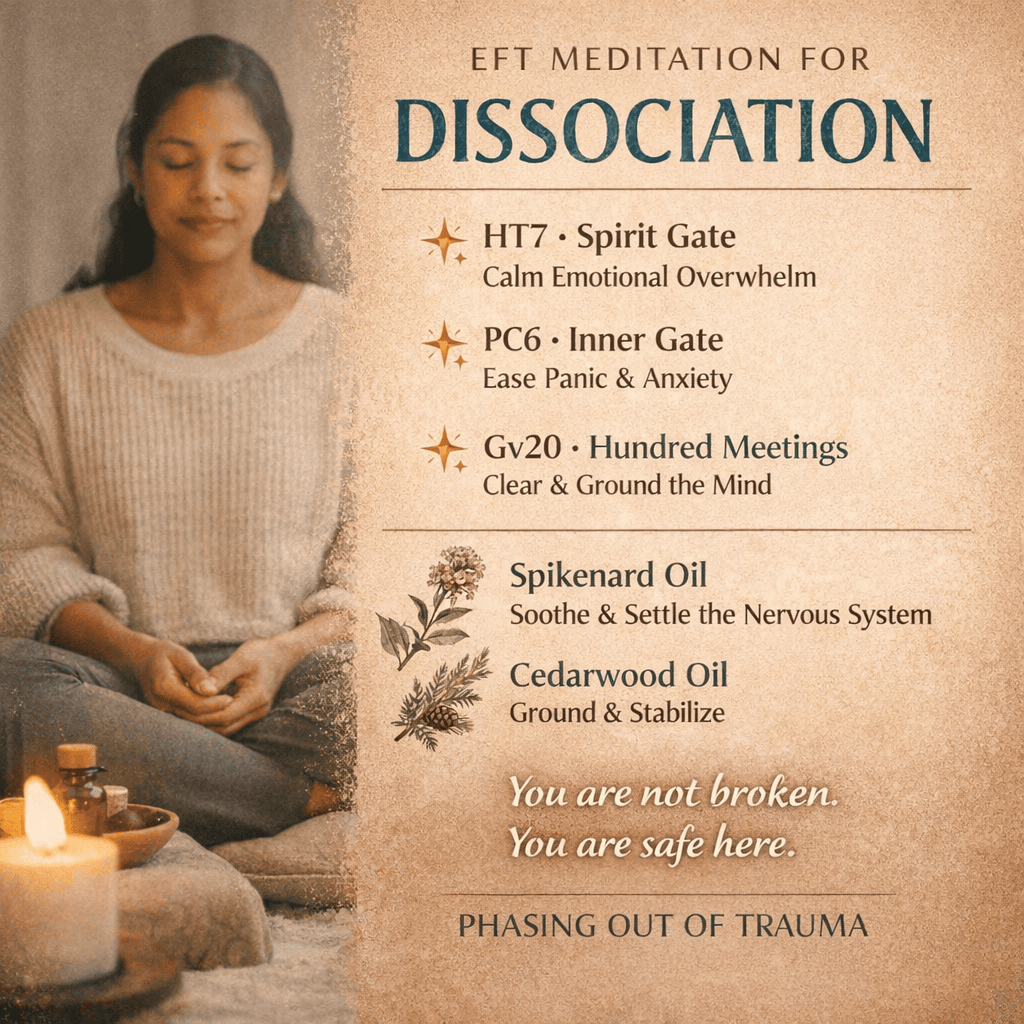
HT7 — Heart 7 (Spirit Gate)
This acupressure point is called the Spirit Gate, and is located at the wrist crease. This point is traditionally used to calm anxiety, emotional agitation, and restlessness. Dissociation can sometimes be an escape from emotional overwhelm and HT7 helps us bring regulation into our emotional center so our bodies do not feel the need to “leave” in order to cope.
This point supports steadiness of heart and spirit, and allows us to be more aware of what our heart and spirit want to communicate to us.
PC6 — Pericardium 6 (Inner Gate)
The Inner Gate point is located on the inner forearm close to the wrist. PC6 is deeply connected to panic regulation, nausea, chest constriction, and heart-mind alignment, tapping here tells our bodies we recognize we're in a state of panic, and that we are using our agency to bring back regulation so that our mind can accept what our heart is feeling.
Whether our dissociation is triggered by full blown panic and anxiety or a quieter plea that things should have been different, PC6 helps calm the physiological cascade from those ruminating thoughts.
It reconnects breath to body.
Heart to mind.
Presence to safety.
GV20 — Governing Vessel 20 (Hundred Meetings)
Hundred Meetings is acutally a point that is often used in EFT meditations even though the training I've had in EFT does not include it as one of the standard points. It is located at the crown of the head, and helps us clear mental fog to bring stability when our awareness has become scattered. While some people worry that tapping the crown may increase dissociation, because we are using this point within this meditation and use several other points, it helps us recognize the feedback and messages from the entire body and supports integration — especially when paired with grounding breaths we use at the beginning and ending of the meditation.
The place of a Hundred Meetings helps bring clarity without overwhelm.
Why We Chose Spikenard and Cedarwood
Essential oils are never magic — but scent is powerful.
Smell connects directly to the limbic system, where memory and emotion are stored. Used gently and safely, oils can support nervous system regulation, and adding additional sensory input in our spiritual practices help infuse this positivie memory into our minds more fully so they begin to be the memories that take up space, and are referred to rather than the traum memories of our past.
Spikenard (Nardostachys jatamansi)
Spikenard is distilled from the root of a Himalayan flowering plant. It has a deep, earthy, grounding aroma. Emotionally, Spikenard supports us and helps us settle when our shock responses have fired; regain a sense of calm when we've need to be hyper-aroused; it encouraging stillness rather than flight or fight; and it helps us soften to reground when there's been spiritual fragmentation.
The scent profile of Spikenard draws our awareness downward — back into the body. It is known historically to be associated with devotion and restoration, it carries a quiet invitation of “Return.”
Cedarwood (Cedrus atlantica)
Cedarwood is stabilizing and strengthening. Emotionally and physically it supports and helps us with nervous system regulation; regain the ability to anchor scattered energy; provide us the agency to reduce anxious rumination; and helps us to create a sense of internal containment.
If dissociation feels like drifting, Cedarwood feels like roots.
Together, Spikenard softens and Cedarwood grounds.
Safety Matters
This practice is slow and invitational.
You are always in control.
Please remember:
• Perform a patch test before first time topical use, don't use essential oils on the skin if you have sensitive skin, it's perfectly fine to apply them to a post-it or cotton ball.
• If you experience severe dissociation, loss of time, or trauma-related flashbacks, share this information with a licensed therapist, and use this as a complementary practice, not as a replacement for therapeutic advice.
• If you become overwhelmed at any time during the meditation, stop tapping, open your eyes, name five things you see, and place both feet firmly on the floor.
This meditation supports healing but is not a substitute for professional mental health care.
If you are in crisis, contact local emergency services or 988 (U.S.).
You Are Not Broken
Dissociation once protected you.
Your body did what it needed to do.
Now, gently — with safety, pacing, and compassion — you can learn to stay.
Stay in your breath.
Stay in your body.
Stay in your story.
And perhaps most importantly —
Stay connected to the God who sees you even when you feel far away.
“With his love, he will calm all your fears. He will rejoice over you with joyful songs.” — Zephaniah 3:17b
To follow along with this meditation, watch the YouTube video here.
You are not broken.
You are learning to return.
If this meditation supports you, we invite you to explore more trauma-informed resources inside Phasing Out of Trauma as we continue integrating faith, nervous system education, and embodied healing — Phase by Phase.